
Why your bed gets hotter after midnight
And why turning the AC down doesn't fix it. A short read for anyone who wakes up hot at 2 AM.
This article is written by Dreamora, the company that makes Luna.
You fall asleep fine. Then around 2 AM you surface in a warm, damp patch. You kick the duvet off, pull it back a minute later, and flip the pillow to find the cool side for the sixth time. The person next to you sleeps perfectly still.
By morning you are foggy and on your second coffee before you have answered a single email. If that sounds like most of your nights, the problem is probably not your room. It is the few centimeters between you and the mattress.
The room is the wrong target
Your body gives off heat all night. That heat collects where you lie: the mattress and sheets hold it against you like a warm sponge. Air conditioning cools the air around that pocket of heat, but barely reaches the surface under your back. A fan pushes warm air sideways. The layer you sleep on stays warm, and it gets warmer as the night goes on.
That is why gel pillows go warm in twenty minutes, and why "breathable" sheets only help for a while. They hold a little heat. They don't move it anywhere.
Cool the bed, not the whole house.
What actually helps: moving the heat
To keep a bed comfortable all night, the heat has to leave the surface, continuously. Water is very good at carrying heat. That is the idea behind every water-cooled bed system, from the $2,000+ smart beds to Luna.
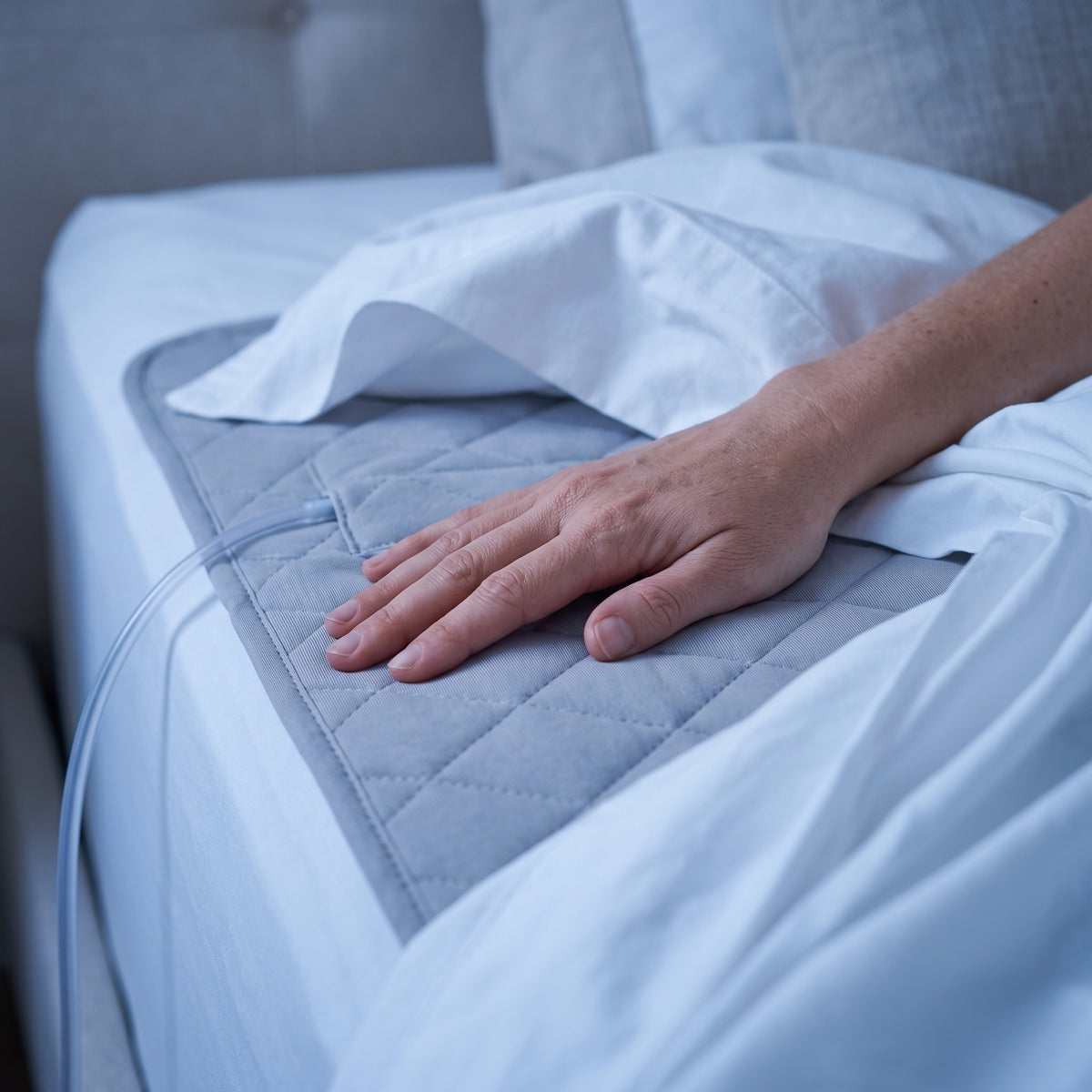
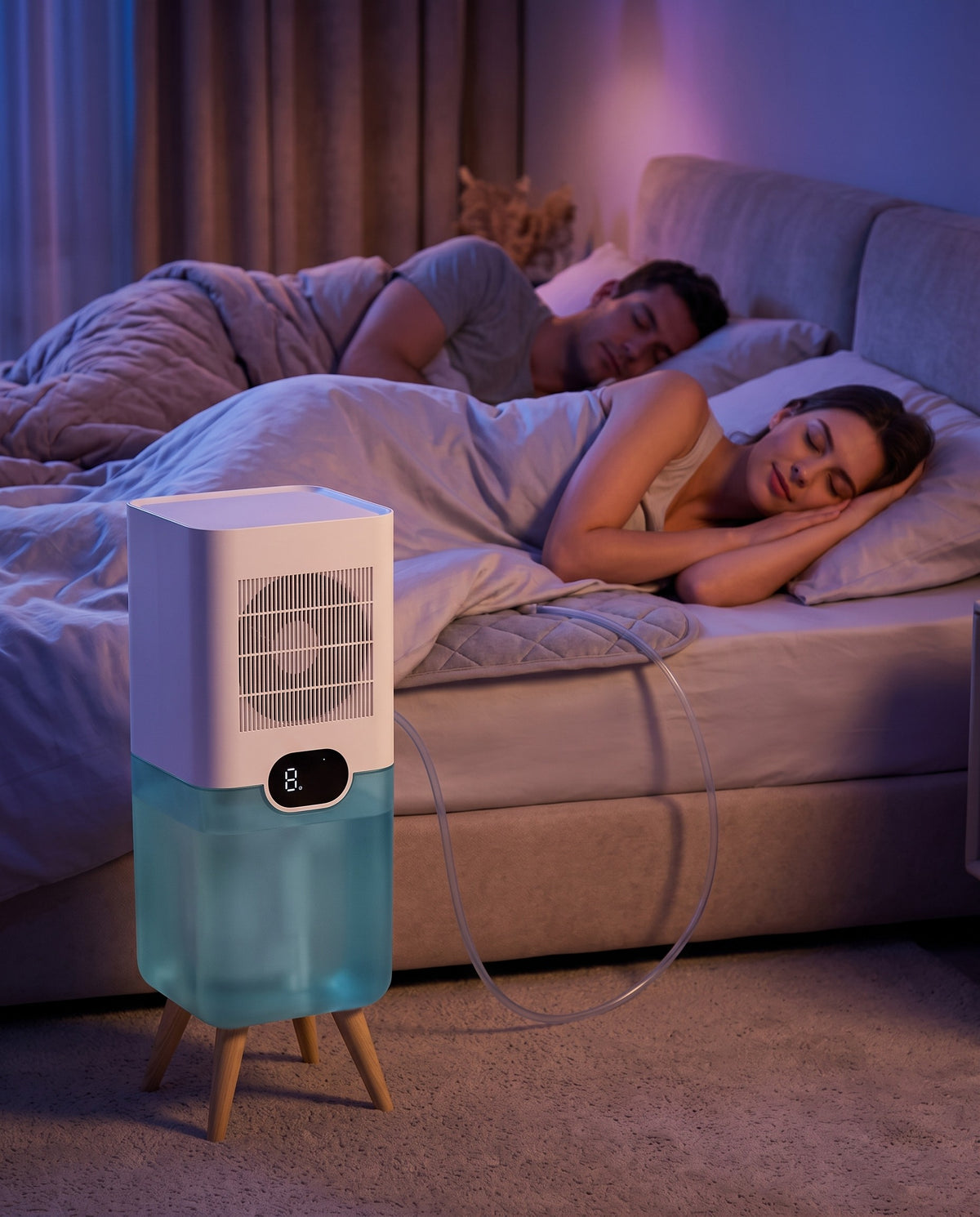
Luna puts a soft quilted pad under your fitted sheet. Water flows through thin channels in the pad and picks up your body heat. It flows back to a small tower next to the bed, runs over an evaporative filter while a quiet fan cools it, then returns to the pad up to 11-14°F below your room temperature. The loop runs all night.
Cool, not cold
Luna is not an ice pack. It is not cold to the touch, and it is not meant to be. Cold surfaces wake you up. Luna's job is to keep removing the heat your body builds up, so your side of the bed stays comfortable from midnight to morning.
Because Luna uses evaporative cooling, it works best in normal to dry rooms. In a very humid room the effect is smaller, and running AC or a dehumidifier helps.
Water up to 11-14°F cooler than your room. From 32 dB. About 8 W. No app, no subscription.
See how Luna works · $199.99Your side only
The pad covers one side of a queen or king bed, so only the person who runs hot gets cooled. Their side stays exactly how they like it. If you both run hot, two Lunas give each side its own unit and its own setting.
What about the expensive ones?
Smart beds like Eight Sleep cool and heat, track your sleep, and cost $1,999 to $2,999, plus a required membership of $199 to $399 a year. Chilipad's Cube costs $719. They do more than Luna. If you only need your side of the bed to stop getting hot, Luna does that one job for $199.99, once.
What the research says, honestly
We won't pretend a cooler bed is a miracle. What research is consistent on is simple: most people rest better when they are not too hot.
- The body cools down in the evening, and that drop in temperature is one of the signals linked to the start of sleep (1).
- In a long-term study of older adults at home, sleep was most efficient at bedroom temperatures around 68-77°F, and less efficient as the room got warmer (2).
- Early research on cooling mattress systems suggests that helping the body shed heat at night may support that natural temperature drop, though the studies so far are small (3).
None of these studies tested Luna. Luna is a comfort product: it keeps your side of the bed cool. That is the whole promise.
One price, no subscription. Two Kickstarter campaigns, 660+ backers.
Get Luna · $199.991. Harding EC, Franks NP, Wisden W. The Temperature Dependence of Sleep. Frontiers in Neuroscience, 2019. PMID 31105512.
2. Baniassadi A, et al. Nighttime ambient temperature and sleep in community-dwelling older adults. Science of the Total Environment, 2023. PMID 37474050.
3. Herberger S, et al. Enhanced conductive body heat loss during sleep increases slow-wave sleep and calms the heart. Scientific Reports, 2024. doi:10.1038/s41598-024-53839-x.
Competitor prices from their US websites and launch coverage, October 2026.